.png)
Stop Leaving Your Best Golf to Chance
Understand why your best golf shows up when it does. Then learn how to create it on purpose, shot by shot, when it matters most.
Thanks for your interest! I truly believe this will help you to discover the wider world of your golf performance to shoot lower scores more consistently. Enjoy reading and if anything you come across starts to resonate with you then book a free coaching enquiry call to chat about your goals and see if we'd be a good fit!

We've all had it. That round where everything clicked. Where decisions felt easy, the swing felt smooth, and the ball went where you were looking. You walked off the 18th wondering: why can't it always feel like that?
The answer isn't more practice. It isn't a new driver. It's a process. A repeatable mental cycle that wraps around every shot you hit, from the moment you arrive at your ball to the moment you walk to the next one.
Most golfers leave performance to chance. When it's good, they enjoy it. When it's not, they blame the swing. But the best players in the world know something different: the mental side of each shot is trainable - not just talent, not just feel, but a genuine skill you can learn, practise, and own.
When you live by this process, everything starts to feel that little calmer, more in control, and less stressful!
How Cole Went From Mid-80s Frustration to Shooting Course Records 62s and Winning Tournaments
When Cole first came to me, the talent was obvious. The swing was there. But when tournament golf arrived, so did the tension.
Like so many good players, the issue wasn’t his technical swing. It was what happened internally when the score started to matter. Nerves would create tension, poor decisions, and the kind of blow-up holes that kept his tournament scoring stuck in the mid-80s.
So we rebuilt his performance cycle from the ground up. We created a disciplined pre-shot routine to quiet his mind, calm his body, and help him swing with freedom under pressure. At the same time, we transformed the way he managed strategy, expectations, and decision-making on the course.
Within three months, the difference was obvious. Not just in his scores, but in his entire demeanour on the course. His parents noticed it immediately. He walked differently between shots. Slower. Calmer. More composed. A bad shot no longer triggered frustration or panic. Instead of reacting emotionally, he learned to reset, reflect, and move forward with awareness and control.
Cole looked calmer, more composed, and far more in control on the golf course. Poor shots no longer spiralled into poor holes, and tournament golf stopped feeling overwhelming.
Cole stopped trying to force performances and started trusting a process.
The result? A transformation from mid-80s tournament scores to multiple rounds of 62, winning competitions and breaking course records.
No swing changes. Just a golfer finally learning how to get out of his own way.

The Process to Follow
What follows is the Performance Cycle. A six-phase framework that covers every moment of a golf shot: before, during, and after. Each phase has a purpose. Together, they create the rhythm that your best golf already lives inside.
You don't need to change your swing. You need to change what surrounds it

Three Stages. Every Shot. On Repeat
.png)
The Performance Cycle is built around three high-level stages that cover every moment of your round - before each shot, after each shot, and the time between shots.
Before
Decisions and Commitment
Make the smart choice, build your routine, and step in with total trust.
After
Response and Acceptance
Stay neutral, learn one thing, let go cleanly, and move forward with intent.
Between
Transition and Reset
Walk with purpose, ground yourself in the present, and arrive ready.
Every step is designed to give you focus and controllables at every stage of your round - to control what you can control and manage your mental and physical response to how you feel about your performance.
The Most Undervalued Skill In Golf
Of everything in this cycle, breathwork is the single most powerful tool you have. It's free. It's always with you. And it works on a physiological level that no thought or mantra can match.
A long, slow exhale activates the parasympathetic nervous system - your body's calm setting - and directly quiets the overthinking part of your brain.

THE STRAW BREATH

3 - 4s
Inhale through the nose
Hold
Brief Pause
+6s
Exhale through pursed lips. Like you have a straw in your mouth
Why it Works
Longer exhale = lower mental volume.
The long exhale activates your parasympathetic nervous system (the body's off switch for stress). It directly quiets the prefrontal cortex, the part that overthinks your swing
When to use it
Before you step in. After the ball lands. On every walk between shots. You'll see it referenced throughout every phase because it belongs in every phase.
"Every golf shot deserves to be hit from a place of calm. And every golfer deserves to know how to create that on demand." - Will
_edited.jpg)
Decisions - Start Building Your Golf IQ
"There's no such thing as a bad lie. There's just a poor decision." - Will
Most golfers start with a number and try to make reality fit the plan. Great decision-making works the other way around: start with the truth of what's in front of you, then choose a shot to match it. This is how you build that mulligan feeling before you've even taken a swing
-
Assess the Lie: What's this lie telling you is possible? Fairway, rough, bare, divot - each one changes contact and trajectory. Honour it, don't ignore it.
-
Read the Slope: Uphill adds loft and shortens carry. Downhill lowers trajectory and adds run. Ball above feet draws. Below curves away. Determine all of this before you choose your shot.
-
Check Your Stance: If you can't stand in balance, you can't swing in rhythm. Can you hold your finish from this base? If not, take less club and simplify.
-
Scan the Window: Is there a genuine shot here, or are you inventing one? Pro players pitch out not out of fear - out of wisdom. That's decisive, not defensive.
-
Plot the Outcome: Wind, air density, ground conditions, elevation. Now - and only now - choose your number and your club. Ask: what's the smartest route, not the bravest one?
-
Preferred Miss: Where can you miss and still make par? Choose a club that lets you swing freely. Clarity removes fear. Process removes pressure.

💡 DID YOU KNOW?
65% of PGA Tour shots end up shorter than intended. Plan for 150 - they hit it 149, 148, 147, 146, 65% of the time. Plan for a short miss in your decision making. You're a human, not a robot.
Your Anchor: "Just because it's your yardage doesn't mean it's your shot."
Commitment - Bullet-proof Your Pre-Shot Routine
"Quiet Mind, Calm Body, Free Swing"
A good decision isn't enough if the body is still tense and the mind still negotiating. The effectiveness of your preshot routine is the thing that needs our full attention next — it's what turns a choice into a free, fluid swing. Most golfers have some form of routine; for most it's inconsistent and not as effective as it could be. We use breathwork to quiet the mind, calm the body, and free the swing.
-
Stand Behind the Ball: This is your thinking zone. Visualise the shot. Build the picture. Decide. Then cross the line and stop thinking.
-
Aim Small, Miss Small: Pick a tiny, precise target - not just the green, but a specific blade of grass or a distant landmark. Specific focus frees the action.
-
Visual Alignment: Find a mark 6–12 inches in front of the ball on your intended line. Square to the near target and you're automatically square to the flag 150 yards away.
-
Load the Picture: See the start line. See the curve. See it land. When the mind holds a vivid image, the body follows.
-
Breathe to Quiet the Mind: Inhale through your nose (3–4 seconds). Hold. Exhale slowly through pursed lips - like breathing through a straw (6+ seconds). One breath. That's all you need to turn down the volume and step in clean.

💡 DID YOU KNOW?
Spend longer behind the ball to spend less time over it. Most golfers get this the wrong way round - they rush behind the ball with no purpose in their routine, then wonder why they freeze or delay over the ball. Slow down back there. It pays off when it matters.
Your Anchor: "Control your breath, quiet your mind, calm your body, relax your swing."
Execution - Swing to a Target, Not at a Ball
"Let go of Control"
This is what all the preparation leads to. Not perfection but presence. The Decision is made. Your routine has taken effect. But the moment you focus on technically swinging the club, tension creeps back in. You tighten. You steer. You override instinct. If that's you, your routine can be improved and I can help you. Your swing should be from a place of commitment and freedom - your natural shot shape 99% of the time, so you don't have to think about your technical swing.
-
Step In with Full Intention: Cross the line only when you're committed. Your glove fastened, your picture loaded, your breath taken. Walk into the shot - don't drift.
-
One Swing Thought Only: Carry a single feel cue into the shot. "Smooth swing." "Full finish." "Trust the line." That's it. One cue quiets the left brain and frees the right.
-
Swing to Something, Not at Something: If chipping, finish with your chest to the target. The strike is a consequence of the finish. The ball is incidental.
-
Better Wrong than Cautious: Even if the club isn't perfect, a fully committed swing will always outperform a hesitant one. Most bad shots aren't technical - they're emotional. Trust unlocks the athleticism you already have.

💡 DID YOU KNOW?
Your swing gets faster under pressure. Your mind speeds up, so your body follows. Your smooth swing becomes your stock swing, so your stock swing becomes your faster swing. Don't fight it - just manage it better with awareness.
Your Anchor: "Smooth and free."
Respond - Protect Your Next Shot Now
"Stay neutral. Learn. Let go." - your next shot starts right here.
Your next shot doesn't begin with club selection. It begins the instant this one lands. Reaction bleeds into rhythm. One bad shot becomes two. One poor hole becomes a lost nine. But you get to choose how you respond. Anger and frustration live within stress-mode - it's your nervous system on high alert, almost as if you already expected the worst. The good news? You now have the tools to interrupt that pattern before it takes hold.
-
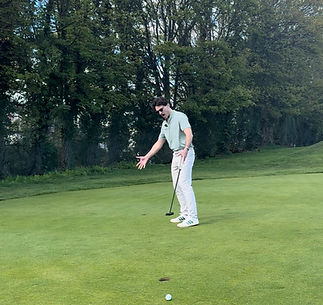
Hold Your Finish: Whether you striped it or scuffed it, stay balanced and upright. Collapsing or flinching spikes tension. Holding still trains composure. "Poor result. Not my best. Composed finish." That's elite thinking.
-
Watch with Neutral Curiosity: Track the ball with interest, not judgment. Did it start on line? Curve as expected? Was that a decision error, a commitment miss, or just a bad strike? Observe like a coach reviewing film.
-
Detach Outcome from Identity: You are not the shot you just hit. Use neutral language: "Right idea, poor strike." Avoid: "Same old story." Those aren't reactions - they're identity statements. They stick.
-
Learn One Thing: Extract a single small insight, then move on. "Breath was too quick." "Went at the flag - commit to my start line next time." Just one. More than that and you're swimming in overthinking.
-
Reset with Breath: Deep inhale through the nose. Long, soft exhale through pursed lips. Shoulders drop. Body relaxes. Eyes lift. "That shot is done. The next one begins now."
💡 DID YOU KNOW?
The vast majority of shots are blamed on poor technique but your technical ability breaks down because of physical tension in the body and doubt in the mind. Reflect on those things first. Make better decisions and prioritise your routines to reduce the pressure on your swing.
Your Anchor: "Reflect don't react. Be curious rather than critical."
Accept - Let Go Without Giving Up
"The shot is done. Let go. Reset. Move forward."
Acceptance doesn't mean you don't care. It means you care enough not to carry what no longer serves you. The ball is gone. The outcome is out of your hands. But your emotional state, your body, and your next decision — those are fully yours.
-
Acknowledge the Emotion: "That stung." "Bit frustrated." Name it without feeding it. Suppressing emotion builds tension. Naming it creates space. You become the observer, not the reactor.
-
Separate Shot from Self: "That shot's over. I'm still here." "I made a mistake. I'm not a mistake." When identity fuses with outcome, emotion takes over. Stay objective and the Mulligan Feeling stays alive.
Take Ownership Honestly: Stick to facts. "Didn't commit." "Alignment rushed." Ownership builds self-trust. You're not spiralling - you're adjusting.
-
Breathe and Release: Straw exhale. Shoulders drop. Pair it with a physical cue: tap your club on the divot, release your glove strap, lift your eyes to the sky. Long exhales tell the nervous system: "We're safe."
-
Recommit to the Present: "Next shot." "Let's go." "What's my next job?" Lift your head. Walk with purpose. This is where the round gets saved - not by making up for mistakes, but by not multiplying them.

💡 DID YOU KNOW?
The faster you accept, the faster you learn how to manage you. One bad shot can stay as one bad shot rather than snowballing into more. Learn what your default setting is and start to use tools to stay ahead of it
Your Anchor: "WIN — What's Important Next?"
Transition - The Mindful Walk
"Recharge and reconnect with the present."
A golf shot lasts seconds. A round lasts hours. What fills the space in between is where most rounds are won or lost. Most golfers ruminate, self-deprecate, or go blank. The best players treat this walk as their edge.
-
Enter the Transition: Head up, shoulders relaxed, steps deliberate. Your body leads your brain. Walk like someone in control - and your mind will follow. Slouching carries frustration forward.
-
Discover your Senses: Take in the view, feel the turf underfoot, the breeze on your skin, the sound of the flag. "Get your head where your feet are." Sensory presence breaks thought spirals instantly.
-
Breathe into Balance: Straw breath again. Match your breath to your steps. Each exhale removes the residue of the last shot. You don't need to talk yourself into calm - just breathe your way there.
-
Let go of Golf: A word with your playing partner. A quiet smile. Light connection reminds you: you're human, and this game can be fun even when it's tough.
-
Prepare to Pause: As you approach your ball, let awareness gently narrow. "What can I see? What can I hear? What's important right now?" Don't go grabbing your range finder or putting your glove on just yet. We've still got to reset. That's the difference between tension and flow.

💡 DID YOU KNOW?
You spend a matter of seconds swinging the club. You spend hours walking between shots. For too many people, this is just "dead time". For us, it is time spent doing the right things to feel good.
Your Anchor:"Get your head where your feet are."
The Reset - Take a Moment, Don't Rush
"Recharge and reconnect with the present."
You've walked from A to B. From the tee to the fairway. From the green to the tee. From your chip to the putt. Your mind is quieter now than it has been in the past. You're standing at your ball. Before the rangefinder comes out, before you whip out your next club, there's one more step: pause with intention. This is the bridge from presence back to performance. Most people have already started making decisions before they even finish their transition. But not us. We're mindful of what's important and why.
-
Pause the Pattern: Place the bag down. Glove on but unfastened. Just stop. Take a sip of water to calm the nervous system. Don't rush into decision mode. Give your mind the space to lead with intention, not impulse.
-
Glance Back: A quick look back at where you came from. That shot didn't take as much to execute as you built it up to be. "Stress-free decisions work." It continues the mindset of simply plotting your way around the course: A to B to C.
-
Grounding Breath: One more straw breath. Feel your shoulders drop, your weight settle, your mind slow. One breath clears more clutter than ten thoughts.
-
Scan your State: Tense? Relax your jaw, breathe slower. Flat? Stand taller, open your chest. Scattered? Slow down. Most poor shots start with poor internal states. Tune the instrument before you perform.
-
Take a Sip: Just a small drink of water is enough to calm your nervous system. It tells your brain, "we're ok".

💡 DID YOU KNOW?
Most people worry about pace of play but they rush the moments that matter. Take your time to prioritise performance, instead of rushing and spending an extra 3-minutes looking for a ball in the trees!
Your Anchor:"End the last cycle as you mean to start the next one. Create Your Calm."
From Theory to Reality
This framework works. But reading it and living it are two different things. Most people have read books, listened to podcasts, and maybe even read something just like this!
But you don't read about swing positions and expect them to land. You don't think about bigger biceps and then hope they appear!
Your mental performance is something we coach, train and work on together. And that's exactly where I help players just like you.
Ready to Own Your Mental Game?
-
Mental - Own your performance, play in full control of you
-
Strategy - Make decisions like your own tour caddy
-
Practice - Create purpose to close the gap between practice and the way you play
-
Prepare - Take the steps tour pros take to ready themselves for the moments that matter
-
Reflect - Adopt a mindful process for your post-round review